State what was received.
Reflect the actual claim, affected environment, and evidence class back to the researcher so both sides know they are discussing the same object.
Silicon Gremlin · Kimbrow Consulting LLC · Blog
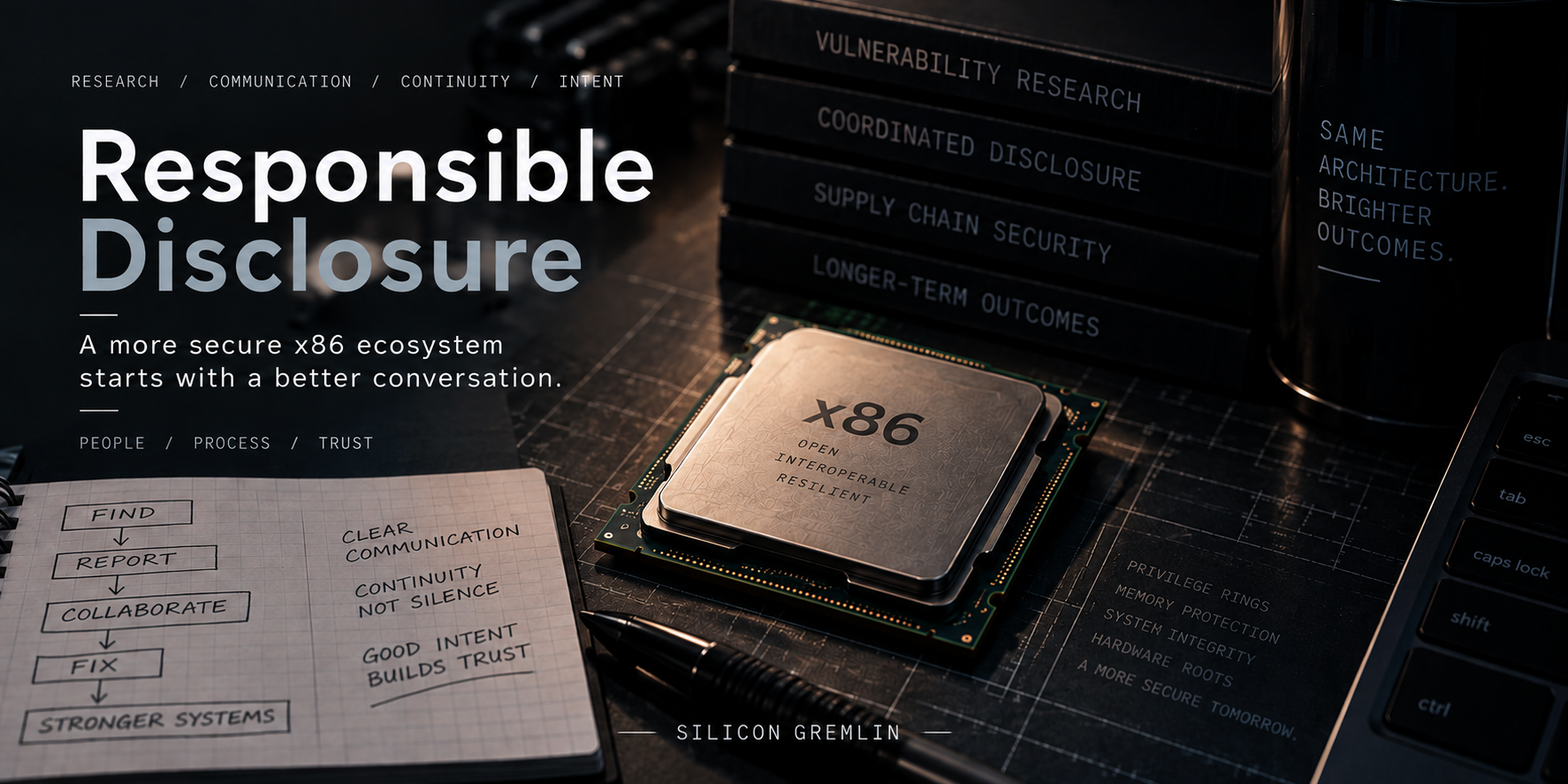
A more secure x86 ecosystem starts with a better conversation.
At some point, a research archive stops looking like a pile of isolated bugs and starts revealing recurring structures in how systems fail.
The same thing can happen to the disclosure process. After enough reports, enough handoffs, and enough time spent translating technical behavior into ticket-sized units, patterns emerge—not only in the systems being studied, but in the way vulnerability information moves between people.
THE PREMISE
The traditional description is simple: a researcher finds a vulnerability, reports it privately, the receiving organization investigates, a fix is developed, and the issue is eventually disclosed. That outline is useful, but it hides the part that determines whether the process feels collaborative or adversarial: everything between report and resolution.
Modern systems are layered. Hardware, firmware, microcode, operating systems, hypervisors, drivers, libraries, runtimes, applications, cloud services, and downstream integrators can all participate in a single observable behavior. The first team to receive a report may not own the layer where the underlying defect lives. The first reproduction may not preserve the state that produced the observation. The report that looks narrow in a queue may be one piece of a larger pattern visible only to the person who has been studying it over time.
Responsible disclosure works best when communication is continuous, context survives handoffs, and everyone involved remains aligned on the same intent: making the system safer.
This is not an argument for researchers to receive privileged access to internal systems, nor for vendors to disclose sensitive investigation details prematurely. It is an argument that the interface between those two sides can be designed better.
COMMUNICATION
A researcher rarely needs a running transcript of an internal investigation. What matters is knowing that the report still has an owner, that the current interpretation is understood, and that materially new evidence has somewhere to go.
That distinction matters. A short update such as “we reproduced the behavior and transferred it to the component owner” communicates far more than a generic status label. So does “we cannot reproduce this in a clean state; please preserve the original environment if possible.” Neither reveals confidential implementation detail. Both preserve coordination.
Communication is not customer service layered on top of security engineering. It is part of the engineering process. When the reporting channel becomes lossy, the technical model on both sides begins to diverge.
CONTINUITY
Ticket systems are good at discrete units. Research is often not discrete.
A report may begin as an image parser crash, a driver transition, a firmware inconsistency, a permissions boundary, or a state-dependent failure. Months later, another observation may expose a structurally similar transition somewhere else. The second report may be independent. It may share a primitive. It may be unrelated. The important point is that the possibility cannot be evaluated if every submission begins from zero.
Continuity does not mean automatically linking every report from the same researcher or forcing unrelated teams into one investigation. It means preserving enough structured context to ask better questions:
The answer may be “no” at every step. That is still useful. A negative correlation is more informative than an unasked correlation.
At architecture depth, continuity becomes especially important because symptoms migrate. The visible manifestation can change while the underlying transition remains similar. A queue organized only around symptoms can lose that relationship.
INTENT
Every disclosure program needs closure states. Reports cannot remain open forever. Duplicates need to be merged. Non-security behavior needs to be separated from exploitable vulnerabilities. Unsupported claims need to be downgraded. Researchers need clear boundaries around what has and has not been demonstrated.
But operational closure and security intent are different things.
The useful objective is not “close the ticket.” It is “reduce uncertainty, reduce exposure, and leave the system better understood than when the report arrived.” Sometimes that ends with a CVE. Sometimes it ends with hardening, telemetry, a documentation change, a duplicate, a product decision, or a conclusion that no security boundary was crossed.
Researchers have obligations here too. Good intent means resisting the urge to inflate impact, treating hypotheses as hypotheses, preserving contradictory evidence, respecting embargoes, and recognizing that an interesting behavior is not automatically an exploitable vulnerability.
HANDOFFS / STATE LOSS
Complex disclosure frequently crosses organizational boundaries: intake to triage, triage to engineering, engineering to another component team, product security to a supplier, one release branch to another, or one organization to a downstream maintainer.
Those transitions resemble any other systems boundary. State has to be serialized. Assumptions have to survive translation. Evidence has to remain attached to the claim it supports. If the handoff compresses the report into a title and a severity guess, the next team inherits a different object than the one the researcher submitted.
This is where continuity and communication meet. The external researcher does not need access to internal routing. But when a handoff changes the investigation materially, a small amount of external synchronization can prevent days or weeks of duplicated work.
A BETTER PROTOCOL
I would treat disclosure programs less like isolated ticket queues and more like long-lived technical coordination systems.
Reflect the actual claim, affected environment, and evidence class back to the researcher so both sides know they are discussing the same object.
Keep reproduction conditions, uncertainty, prior negative tests, related reports, and artifact provenance attached to the investigation.
Updates do not need to reveal internal details. Ownership changes, reproduction results, scope changes, and requests for new evidence are often enough.
Give triage teams a way to notice recurring primitives, boundaries, components, and researchers' prior work without automatically assuming common cause.
When possible, distinguish “not reproduced,” “not security relevant,” “duplicate,” “fixed,” and “accepted risk” instead of collapsing different outcomes into the same experience.
A strong program should become better at recognizing familiar failure structures as its archive grows.
None of this requires turning a vulnerability program into an open engineering forum. It requires treating information continuity as part of risk reduction.
RESPONSIBLE DISCLOSURE / x86
x86 is a useful visual metaphor precisely because nobody expects one layer to explain the whole machine. Privilege rings, page tables, firmware, microcode, memory protection, drivers, runtimes, and hardware roots all interact through defined boundaries. We spend enormous effort making those boundaries explicit because hidden state and broken assumptions are where interesting failures live.
The disclosure process deserves the same systems thinking.
Researchers should be precise about what they know. Receiving organizations should preserve what was reported. Both sides should communicate when the state changes. And everyone should remember why the process exists in the first place.
Find. Report. Collaborate. Fix.
Then carry the context forward so the next report starts from a stronger system, not an empty queue.